Field guideService 05 of 05 · Grow
I build business systems that scale.
The backend a business grows on: a CRM at the center, every tool wired into it, and leads routed the moment they arrive. Built so growth adds capacity, not chaos.
 By Ezra A. Gonzalez · San Diego9 min read · 9 chapters
- dealer sites on one repeatable system
- SEO pages deployed for one network
- cold emails sent by systems I built
Chapter 01 · Who it’s for
The signs a business has outgrown its setup.
Scattered
Every customer’s story is split across five tools.
The inbox has the first message, a spreadsheet has the quote, the booking app has the appointment and someone’s phone has the texts. Each tool works. None of them agree, and nobody sees the whole picture.
Dropped
Leads arrive faster than the right person can reach them.
Inquiries come in at night, on weekends and through four channels, and they land with whoever checks first. Some get answered twice, some never. The fix isn’t more effort. It’s routing.
Blind
You can’t say which marketing produced which sale.
The ad platform reports clicks, the CRM (if there is one) holds names and the bank holds the revenue. Until they’re connected, every budget decision is a guess.
Expanding
A second location would mean doing everything twice.
The business runs because you, or one good employee, remember how it runs. A new location, a new service line or a new hire exposes every step that was never written down.
Chapter 02 · What it means
A scalable system lets growth add capacity, not chaos.
Most small businesses don’t have a system. They have a stack of tools, each bought to fix one problem the week it showed up: a booking app, a form builder, an email tool, a spreadsheet, a phone. Each one works. Together they don’t, and the gaps between them get filled by people copying, pasting and remembering.
A scalable system replaces the stack with a structure: one record for every customer, every tool connected to it, and the human steps written down. Scalable means the next customer, the next location or the next hundred pages take less effort than the last ones did, not the same effort again.
It has seven parts. Most businesses have two or three of them, usually bought in the wrong order.
The seven parts, in build order
- 01
The CRM
One record for every lead, patient or customer, with the full history attached. Everything else here writes to it or reads from it.
- 02
Intake
The forms, calls, chats and bookings that capture a lead, collecting the same clean fields every time.
- 03
Integrations
The website, ads, phone, email, calendar and payments wired to the CRM, so information moves on its own instead of by copy and paste.
- 04
Routing
Rules that send each lead to the right person, location or provider the moment it arrives, and start the follow-up on their own.
- 05
Dashboards
Reporting pulled from the CRM, so you can see where leads come from, where they stall and which ones turn into revenue.
- 06
SOPs
Written procedures for the steps people still own, so a new hire or a new location runs the same way the first one did.
- 07
Deployment
A repeatable way to stand up the next page, site or location from what already works, instead of starting from scratch.
An automation built on messy data just makes the mess faster.
Dashboards and automations get bought first because they’re the parts you can see. The CRM and clean intake go in first, because routing, reporting and repeating all depend on knowing where every customer lives.
Chapter 03 · How it gets built
How I build a system, from audit to rollout.
Paper before software. I design the whole system before anything gets set up, then build it from the CRM out.
- Plan
Step 01 · Plan
Audit
I map how the business actually runs today: every tool, every form, every place a lead can land, and every step that runs on memory.
You get
- A map of your tools and data
- Every gap and overlap, listed
Step 02 · Plan
Architect
I design the system on paper: the CRM structure, the fields, the pipeline stages, what connects to what, and who gets which lead.
You get
- CRM and pipeline design
- Integration and routing map
- Build
Step 03 · Build
Build the core
The CRM gets set up or cleaned up, overlapping tools get consolidated, and intake is rebuilt so every form and call writes clean data to one place.
You get
- CRM setup or cleanup
- Intake forms
- Tool consolidation
Step 04 · Build
Connect and route
The website, ads, phone, email and calendar get wired in. Routing rules send each lead where it belongs, and follow-up starts on its own.
You get
- Integrations
- Lead routing
- Automation workflows
- Grow
Step 05 · Grow
Measure
Dashboards go live on top of the CRM, with reporting loops that show what’s working, so decisions get made on numbers instead of on memory.
You get
- Dashboards
- Reporting loops
Step 06 · Grow
Repeat
The steps people still own get written down, and what works gets packaged so the next page, site or location is stood up from it. As the business grows, the system gets upgraded, not rebuilt.
You get
- Internal SOPs
- Content and page deployment systems
Chapter 04 · Case studies
Two systems built to be repeated.
One stands up custom websites for luxury watch dealers. The other qualifies and routes patients to providers nationwide. Different industries, same idea: build the structure once, then let the volume run through it.
Case 01
Watch Dealer Websites
Custom websites for luxury watch dealers, with a repeatable system underneath that stands up each new dealer’s site fast.
- Luxury watches · Owned and run
- Ongoing · 70+ dealer sites

- custom dealer sites, none from a template
- of dealers sent by another dealer
- watches dealers sell through the sites and e-commerce I built
Watch Dealer Websites is my company. It builds custom websites, marketing and lead generation for luxury watch dealers and fine jewelers. It has built more than 70 dealer sites, and every one of those dealers was sent by another dealer.
That creates a systems problem. Referrals don’t arrive on a schedule, and no dealer wants a site that looks like the last one. A template would solve the speed and ruin the trust. Doing every site by hand would protect the trust and cap the business.
So the system is what repeats, not the design. Underneath every custom site is a repeatable way to stand up a new dealer fast, run dozens of times over. Each dealer still gets a site built from scratch to look as established as their inventory.
What was built, in order
TodayEach new referral gets a site designed from scratch and stood up on the same system as the 70+ before it.
Case 02
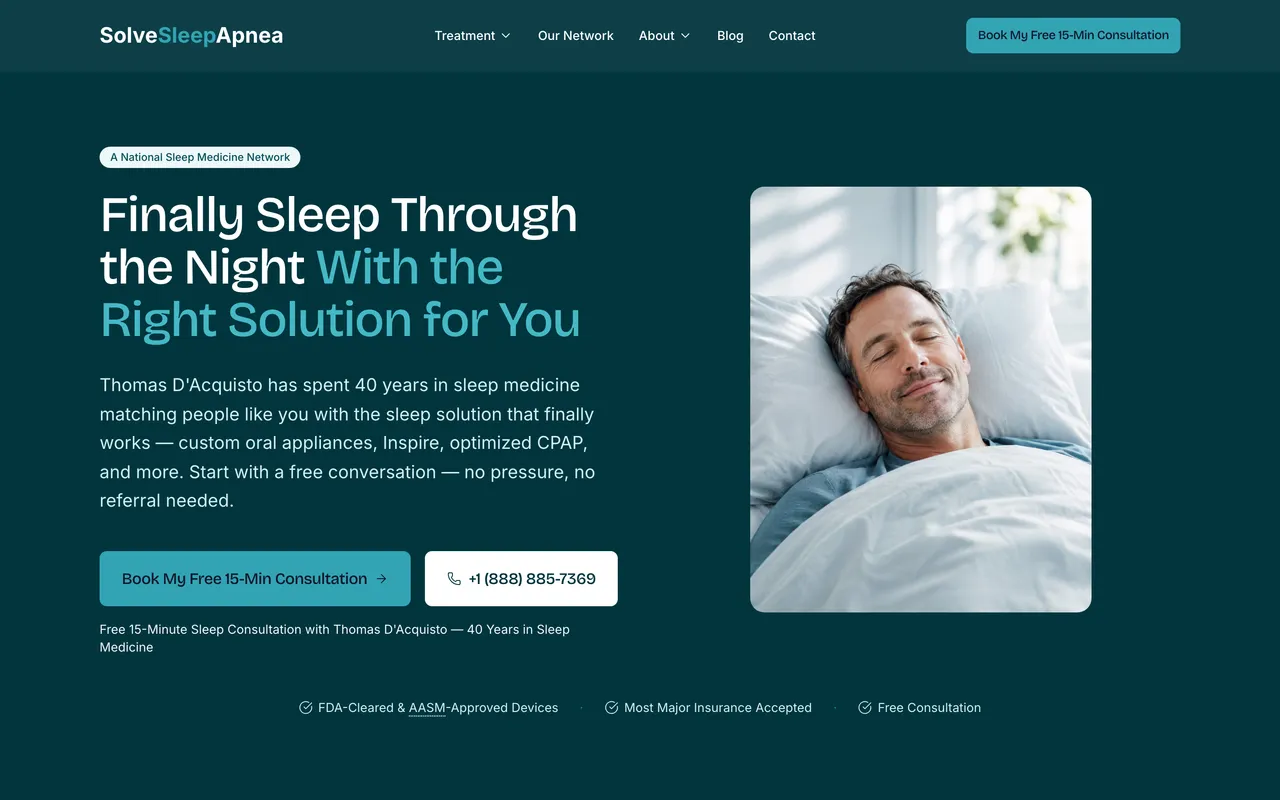
Solve Sleep Apnea
A nationwide sleep apnea network, built on a backbone that qualifies and routes patients to partner providers around the clock.
- Healthcare · Co-founded
- Built in 9 months
- patients qualified and routed by AI agents
- SEO pages deployed by location and keyword
- compliance designed into the backbone
I co-founded Solve Sleep Apnea, a nationwide network for commercial drivers and everyday people who need answers about sleep apnea. From the systems side, the hard part was never the website. It was moving each patient from a first question to the right partner provider without anyone falling through.
So the backbone was designed around that path: HIPAA compliance, a CRM and an automation system, with AI agents, including voice agents, that answer patient calls, texts and email, book and reschedule appointments, and qualify and route patients 24/7. The team runs the consultations; the system handles the rest.
Search was built the same way. More than 100 SEO pages went live to rank by location and keyword. At that number, pages stop being a writing project and become a deployment problem: the structure has to be designed once so every page can be built from it.
What was built, in order
TodayPatients are qualified and routed around the clock, and the team spends its time on consultations instead of coordination.
Chapter 05 · Field notes
What these builds taught me about systems.
A few rules I now apply to every system, and where each one came from.
Note 01
Repeat the system, not the design.
Watch Dealer Websites has built 70+ dealer sites without a template. What repeats is the process underneath: how a new dealer gets stood up. Standardize the inside, and the outside can stay custom.
Note 02
Settle the data rules before the tools.
At Solve Sleep Apnea, HIPAA compliance is part of the backbone, not an add-on. The rules for where patient information may go decide which tools qualify and how they connect, so they come before the CRM.
Note 03
Route at the moment of contact.
Solve Sleep Apnea’s patients are qualified and routed 24/7. A lead that waits for someone to check an inbox has already started to cool. Routing rules don’t keep business hours.
Note 04
If you need a hundred pages, design one structure.
Solve Sleep Apnea has 100+ SEO pages built to rank by location and keyword. At that scale a page can’t be its own project. Design the structure once, and the next page is a fill, not a rebuild.
Note 05
Own your system.
Everything I build lives in your accounts, on standard platforms, documented. A system you can’t see into or take with you is a dependency, not an asset.
FromEvery build
Chapter 06 · The first step
It starts with a Strategic Blueprint.
Before I touch your CRM, we map the business on paper. For a systems project, the Strategic Blueprint is an audit and a design: how leads, customers and information move today, where they leak, and the system that replaces the patchwork, sequenced so the foundation goes in first.
It’s yours to keep. Build it with me, with your team or on your own.
What’s included
- 01Audit of your current tools, data and workflows
- 02CRM and pipeline design
- 03Integration map: what connects to what
- 04Lead routing rules
- 05Dashboard and reporting plan
- 06Build sequence and priorities
You leave with
- A map of how the business runs today
- The system design, on paper
- Which tools to keep, replace or consolidate
- Routing and follow-up rules
- The numbers your dashboards should show
- A priority-ranked build plan
A Strategic Blueprint usually takes about 10 business days. Depending on the business, anywhere from 2 to 14.
Connect With Me →Chapter 07 · Working together
How we’d work together.
01 · Free
Connect
Text, call or send a message. Tell me which tools you use and where things fall through, and I’ll tell you where I’d start.
02
Strategic Blueprint
We audit what you have and design the system on paper, and you get the written plan.
03
We build it together
I stay on as your consultant, your builder, or both, from the CRM to the dashboards and SOPs, and I upgrade the system as the business grows.
Chapter 08 · Questions
Common questions about Scalable Systems.
What is a scalable business system?
It’s the backend that lets a business take on more customers, locations or services without the work growing at the same rate. In practice: a CRM at the center, every tool connected to it, rules that route each lead, dashboards that show what’s working, and SOPs and deployment that let you repeat it.
What’s the difference between Scalable Systems and Business Automations?
Business Automations handle tasks: answering, following up, booking. Scalable Systems is the structure those automations run on: the CRM, the data, the connections and the written procedures. Automations built without that structure tend to break the first time something changes.
Which CRM should my business use?
The one that fits how your business actually runs, which is why the design comes before the software. I build on standard platforms, set up in your accounts. If the CRM you already pay for can do the job, I’d rather clean it up than replace it.
Can you clean up the CRM and tools we already have?
Yes. CRM setup or cleanup and tool consolidation are part of the work. Often the fix isn’t a new tool. It’s connecting the ones you have and retiring the ones that overlap.
What is lead routing?
Rules that decide who handles each new lead the moment it arrives, by location, service, provider or availability, and start the follow-up on their own. At Solve Sleep Apnea, AI agents qualify and route patients 24/7, so nobody waits for someone to check an inbox.
Do you build systems for medical and healthcare businesses?
Yes. I’ve built multiple medical businesses. Solve Sleep Apnea’s backbone includes HIPAA compliance, the CRM and the automation system. I also built the CRM, the website and the social media for Dr. Bertrand Desilva, a board-certified sleep physician offering telehealth consultations.
Will I be locked into your tools?
No. Everything lives in your accounts, on standard platforms, documented. If we ever stop working together, the system keeps running and your team knows how it works.
How long does it take to build?
It depends on how many tools, locations and people are involved. The Strategic Blueprint comes first, usually in about 10 business days, and it gives you the build plan and the timeline.
Do you only work with businesses in San Diego?
San Diego is home and where most of my work comes from, almost all of it by referral. I also work nationwide and globally. A well-built system doesn’t care where you are.