Field guideService 03 of 05 · Build
I build automations that answer every lead.
AI agents for calls, texts and email, plus the follow-up, booking, routing and CRM workflows behind them. Built from scratch for your business, with people in charge of anything that needs judgment.
 By Ezra A. Gonzalez · San Diego8 min read · 9 chapters
- AI agents on call at Solve Sleep Apnea
- compliance built into the system
- channels the agents answer: calls, texts and email
Chapter 01 · Who it’s for
What’s slipping when people call me.
After hours
Leads reach out when nobody’s there to answer.
Calls go to voicemail at night, forms sit over the weekend, and by the time someone calls back the lead has booked with whoever answered first. People reach out when it suits them, not during your hours.
Busywork
Your team spends the day on the same few tasks.
Answering the same questions, confirming and rescheduling appointments, chasing missed calls, copying details into the CRM. Necessary work, and almost none of it needs a person’s judgment.
Growth
More leads would break the way you work now.
Every new lead is another call to return and another follow-up to remember. You want to grow without the follow-up falling apart, and without hiring for work a system can do.
Healthcare
You handle information that has to be protected.
Patient details, intake, scheduling. You want automation, but not at the cost of compliance, or of a wrong answer going out with no one checking. That’s the kind of system I build and run.
Chapter 02 · What it means
Business automation is the next step, taken every time.
Business automation means the routine steps of running a business happen on their own, every time: the call gets answered, the new lead gets a reply, the appointment gets booked and confirmed, and the record gets updated. Nobody has to remember to do it.
AI agents are the newest part. They’re software that can hold a real conversation by phone, text or email, ask the qualifying questions and take an action, like booking a time or sending the conversation to the right person. They’re useful, but only as useful as what they’re connected to. A working system has six parts, and the agent is the last one.
The six parts, in build order
- 01
The map
Every way a lead or customer reaches you, and every step after. Written down, it shows what repeats, what needs judgment and where leads get lost.
- 02
The CRM
One place every lead, conversation and appointment lands. Without it, automation scatters information instead of organizing it.
- 03
The rules
Who qualifies, where each lead goes by location, service or urgency, and when a person takes over. Decided by you, written down, then built in.
- 04
The follow-up
Text and email sequences for new inquiries, missed calls, confirmations and reminders. The work that most often doesn’t happen when it’s done by hand.
- 05
The booking
Scheduling tied to the real calendar, so people can book, confirm and reschedule without waiting on anyone.
- 06
The agents
AI voice, text and email agents that answer, qualify and book in a real conversation, using everything above, and hand off to a person by the rules.
The AI agent is the last thing to build, not the first.
Without a CRM, rules and a calendar, an agent can only talk. On top of them, it can qualify a lead, book the visit and hand the hard questions to a person.
Chapter 03 · How it gets built
How I build automations, step by step.
Map the work, write the rules, then build from the CRM up to the agents. The agents go live last, and they keep improving after launch.
- Plan
Step 01 · Plan
Map the work
We walk through how leads and customers reach you today: calls, texts, forms and email. I list every step that follows, who does it and where it breaks, so we automate what repeats and keep people on what needs judgment.
You get
- Workflow map
- Where leads are lost today
Step 02 · Plan
Write the rules
Qualification questions, routing by location, service or urgency, what the agents may and may not say, and exactly when a conversation goes to a person. You approve every rule before it becomes software.
You get
- Lead routing logic
- Escalation rules
- Build
Step 03 · Build
Connect the CRM
I connect your CRM to your phone, text, email, website forms and calendar, or set one up if you don’t have one, so every conversation lands in one place.
You get
- CRM integration
- Every channel in one place
Step 04 · Build
Build the follow-up
Text and email sequences for new inquiries, missed calls, confirmations, reminders and rescheduling, written in your voice and triggered by what each lead actually does.
You get
- SMS and email sequences
- Booking and reminders
Step 05 · Build
Build the agents
Voice, text and email agents trained on your business and your voice, connected to the CRM and the calendar so they can qualify, route and book, not just take messages.
You get
- AI voice, text and email agents
- Documentation
- Grow
Step 06 · Grow
Test, launch and tune
Every path is tested before a real customer reaches it. After launch I review conversations, tighten the rules and tune the agents as the models improve.
You get
- Testing and tuning process
- Ongoing human oversight
Chapter 04 · Case studies
How Solve Sleep Apnea’s agents work.
One business in depth, from a patient’s first message to the consultation: what the agents do, what sits underneath them, and what stays with people.
Case 01
Solve Sleep Apnea
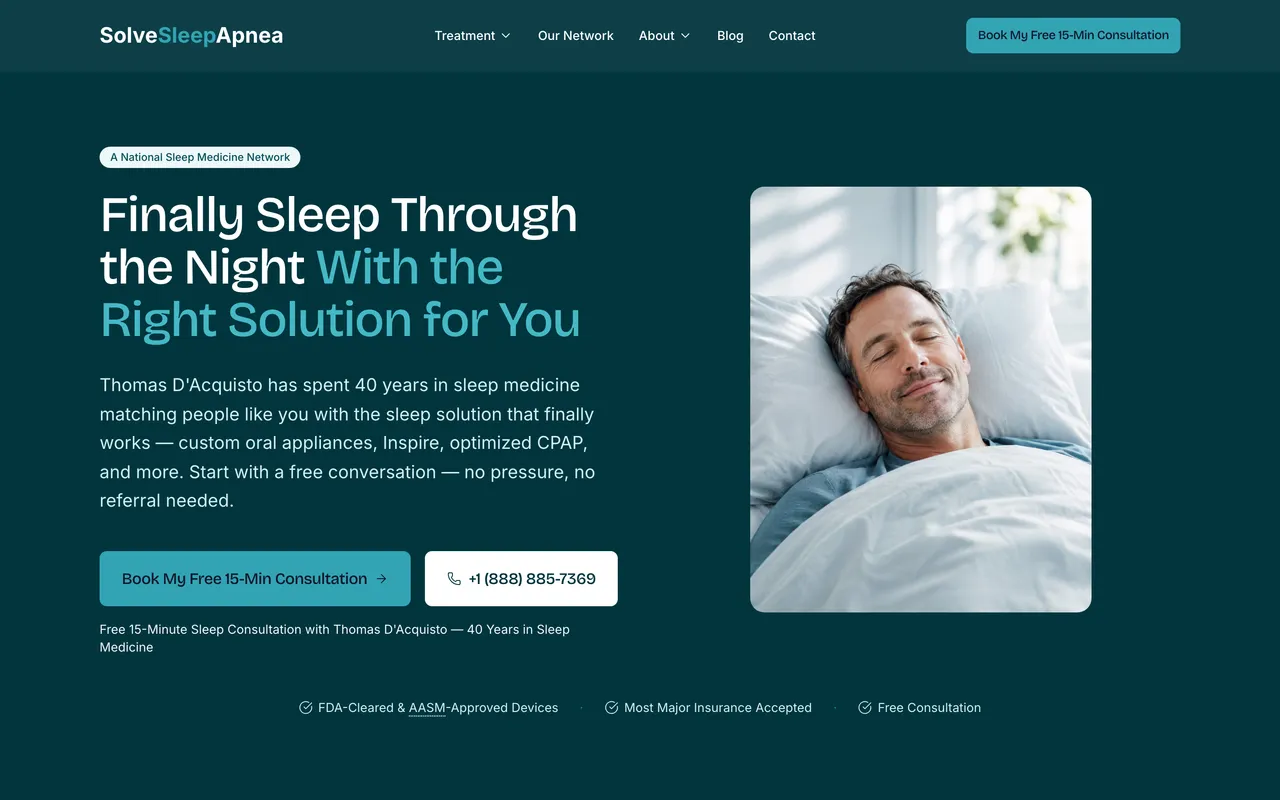
A nationwide sleep apnea network where AI agents answer, qualify, book and route patients around the clock, so the team can focus on consultations.
- Healthcare · Co-founded
- Built in 9 months, agents included
- patient calls, texts and email answered by AI agents
- channels the agents cover: phone, text and email
- months to build it all, agents included
Solve Sleep Apnea helps commercial drivers and everyday people get answers about sleep apnea and get matched with the right partner provider, nationwide. People reach out when they can: late at night, on weekends, between shifts. Office hours can’t cover that. A system can.
So the first response never depends on someone being at a desk. AI agents, including voice agents, handle patient communication by phone, text and email: answering questions, qualifying each patient, setting appointments, rescheduling, and routing every patient to the right next step, 24 hours a day.
Under the agents is the part patients never see: the CRM, the automation system that moves each patient forward, and HIPAA compliance, because this is health information. I built all of it from scratch in the same nine months as the brand, the website and the provider network.
The people do the part that needs people. Our team runs the consultations and matches each patient with the right partner provider. Anything an agent shouldn’t decide goes to them.
What was built, in order
TodayPatients nationwide get an answer at any hour, by phone, text or email. The team’s time goes to the consultations.
Chapter 05 · Field notes
What running AI agents in healthcare taught me.
The rules every automation I build now follows.
Note 01
Write down when a person takes over.
Every system I build has escalation rules: what an agent never answers alone, and when a conversation goes to a person. In healthcare a bad automated answer has real consequences, so those rules come before the agent.
Note 02
Answer at the hour people reach out.
Patients reach out late at night, on weekends, between shifts. At Solve Sleep Apnea the agents answer calls, texts and email 24/7, so a first message never sits until morning.
Note 03
Automate the rescheduling, not just the booking.
Booking is the easy half. At Solve Sleep Apnea the agents also reschedule, because a missed appointment that’s never rebooked is a patient lost after all the work it took to reach them.
Note 04
Build compliance in, not on.
Solve Sleep Apnea handles health information, so HIPAA compliance was part of the build, with the CRM and the agents. If you handle sensitive information, the automation is designed around it, not patched afterward.
Note 05
Fix the process before you automate it.
Automating a messy process just makes the mess faster. The workflow map comes first, so what gets automated is the follow-up you actually want.
FromEvery build
Chapter 06 · The first step
Automation starts with a Strategic Blueprint.
Before anything is automated, we put the work on paper. The Strategic Blueprint maps how leads and customers move through your business today, decides what should run on its own and what should stay with people, and puts the build in order.
It’s yours to keep. Build it with me, with someone else or on your own.
What’s included
- 01Workflow and lead-flow mapping
- 02CRM review or recommendation
- 03Qualification and routing design
- 04Escalation and handoff rules
- 05Follow-up and booking plan
- 06Agent scope and boundaries
You leave with
- A workflow map
- Where leads are lost today
- Lead routing logic
- Escalation rules
- A CRM plan
- SMS and email sequence outlines
- What each agent will and won’t handle
- Priority-ranked automation plan
A Strategic Blueprint usually takes about 10 business days. Depending on the business, anywhere from 2 to 14.
Connect With Me →Chapter 07 · Working together
How we’d work together.
01 · Free
Connect
Text, call or send a message. Tell me where leads get stuck or what eats your team’s day, and I’ll tell you what I’d automate first.
02
Strategic Blueprint
We map the work, write the rules and put the automation plan on paper.
03
We build it together
I build the CRM, the follow-up and the agents, then stay on to review and tune them, as your consultant, your builder or both.
Chapter 08 · Questions
Common questions about Business Automations.
What is business automation?
It’s setting up the routine steps of your business to happen on their own: answering common questions, replying to new leads, booking and confirming appointments, routing inquiries and updating the CRM. AI agents are one part of it. The CRM, the rules and the follow-up underneath them are the rest.
Can an AI agent answer my business phone?
Yes. A voice agent can pick up at any hour, answer common questions, qualify the caller, book or reschedule an appointment and pass the call to a person when it should. The same logic works by text and email. At Solve Sleep Apnea, agents handle patient calls, texts and email 24/7.
Will AI talk to my customers without oversight?
No. Every system I build ships with escalation rules, review points and clear boundaries. Automation handles volume; people handle judgment.
Will automation replace my staff?
It replaces the repetitive part of their day, not the people. At Solve Sleep Apnea the agents handle the calls, texts, email and scheduling, and the team spends its time on consultations, the work that actually needs them.
Can AI automation be HIPAA compliant?
It can, if it’s built that way from the start. Solve Sleep Apnea handles patient information, so HIPAA compliance was built into the system along with the CRM and the agents. In healthcare, compliance decides which tools we use and what the agents are allowed to do.
Does it work with my CRM?
I connect the agents and automations to your CRM, or set one up if you don’t have one, so every conversation lands in one place.
How long does it take to set up?
It depends on what’s already in place. A business with a working CRM and clear rules is further along than one starting from scratch. The Strategic Blueprint comes first, usually in about 10 business days, and it sets the timeline for the build.
What kinds of businesses do you automate?
Any business that runs on leads, calls and appointments. I generate leads for restaurants, luxury retail brands and medical businesses. I’ve built multiple medical businesses, including Solve Sleep Apnea, and the CRM, website and social media for Dr. Bertrand Desilva’s telehealth sleep practice. My cold outreach systems have sent more than 1,000,000 emails.
Do you build automations for businesses in San Diego?
Yes. San Diego is home and where almost all of my work comes from, by referral. I also build nationwide: Solve Sleep Apnea’s agents work with patients across the country.