Field guideService 04 of 05 · Grow
I measure marketing in revenue, not clicks.
Marketing and advertising for businesses that need customers: SEO, Google and Meta ads, content, email and cold outreach, built on the landing pages, follow-up and tracking that turn a click into a sale.
 By Ezra A. Gonzalez · San Diego9 min read · 9 chapters
- cold emails sent through my outreach systems
- SEO pages built to rank one network by location
- followers built before a deli opened its doors
Chapter 01 · Who it’s for
What’s usually going on when someone calls me about marketing.
Paying for ads
You’re spending on ads, but you can’t tell what’s working.
The ad platform reports clicks. Your books report sales. Nothing connects the two, so every budget decision is a guess about which dollars are coming back.
Hard to find
People search for what you sell, and find someone else.
Your competitors show up on Google and in the map results. You show up for your own name, if that. Search keeps working after the work is done, and right now it’s working for them.
No pipeline
Referrals built the business, but they don’t arrive on schedule.
Word of mouth is the best lead there is, and you can’t turn it up. Outreach, search and ads give you a pipeline you control, so a slow month is something you can fix.
Chapter 02 · What it means
Marketing is the whole path from stranger to sale.
Most people say marketing and mean the part they can see: the ads, the posts, the emails. That’s the front of it. Marketing is the whole path a stranger takes to become a customer: where they first hear of you, where they land, how they’re captured, how fast someone answers, and whether the sale gets traced back to what started it.
Advertising is the part of that path you pay for. It’s the fastest part to turn on and the easiest to waste money on, because paid traffic only scales what already exists.
The path has six parts. Most businesses have one or two, built at different times by different people. The work is building all six so each one hands the customer to the next.
The six parts, in build order
- 01
The audience
Who you’re trying to reach, what they search for and the words they use for the problem. Every ad, page and email borrows from this, so it comes first.
- 02
The landing page
Where the click lands. One page, one offer, one next step, written for the exact person the campaign is aimed at. Not the homepage.
- 03
The follow-up
The form, the calculator or the booking link, then the email, text or call that answers. A lead that waits goes cold, and nobody sees it happen.
- 04
The tracking
Every lead tagged with where it came from and followed to the sale, so cost per lead, cost per sale and revenue by campaign are numbers, not guesses.
- 05
Owned channels
SEO, content, your email list and social. They’re slow to start, they compound, and they keep working when the budget stops. Start them early.
- 06
Ads and outreach
Google and Meta ads and cold email. The fastest way to send people down the path, which is exactly why they go last: they scale whatever is already there.
Build it backward from the sale.
Ads are the last thing to turn on, because they only scale what’s underneath them: if the page, the follow-up or the tracking is weak, ads just make the leak more expensive.
Chapter 03 · How it gets built
How a campaign gets built, from the audit to the report.
Plan the path, build it, then send people down it. The order is the same for a deli’s email list and a medical network’s search pages. Only the channels change.
- Plan
Step 01 · Plan
Audit
I trace the path you have now, from the first search or ad to the sale: the offer, the pages, the follow-up, the tracking and the sales process. If something underneath is weak, you hear it before a dollar goes to ads.
You get
- A map of your current path
- The leaks, in priority order
Step 02 · Plan
Strategy
We define the audience, the offer and the numbers that matter, then choose the channels that reach that customer: search, ads, content, email or outreach. Not all of them. The right ones, in order.
You get
- Audience and offer strategy
- Channel plan
- Target cost per lead and per sale
- Build
Step 03 · Build
Foundation
The landing pages, the lead capture, the follow-up and the conversion tracking, wired end to end before any traffic arrives, so every lead is attributable from day one.
You get
- Landing pages
- Lead capture and follow-up
- Conversion tracking
Step 04 · Build
Launch
Campaigns go live on the channels the plan chose: Google and Meta ads, SEO pages and content, email campaigns or cold outreach, each one tracked on its own.
You get
- Campaign structure
- Creative testing plan
- SEO and content plan
- Grow
Step 05 · Grow
Optimize
A weekly review against revenue. Scale what works, cut what doesn’t, and test the next headline, audience, page or subject line.
You get
- Weekly review against revenue
- Ongoing creative and page tests
Step 06 · Grow
Report
A dashboard with cost per lead, cost per sale and revenue by campaign, so you can see what your marketing earns without having to ask me.
You get
- Reporting dashboard
- Monthly optimization loop
Chapter 04 · Case studies
How two businesses get their customers.
One is found through search and answered around the clock. The other built its audience a year before it had anything to sell.
Case 01
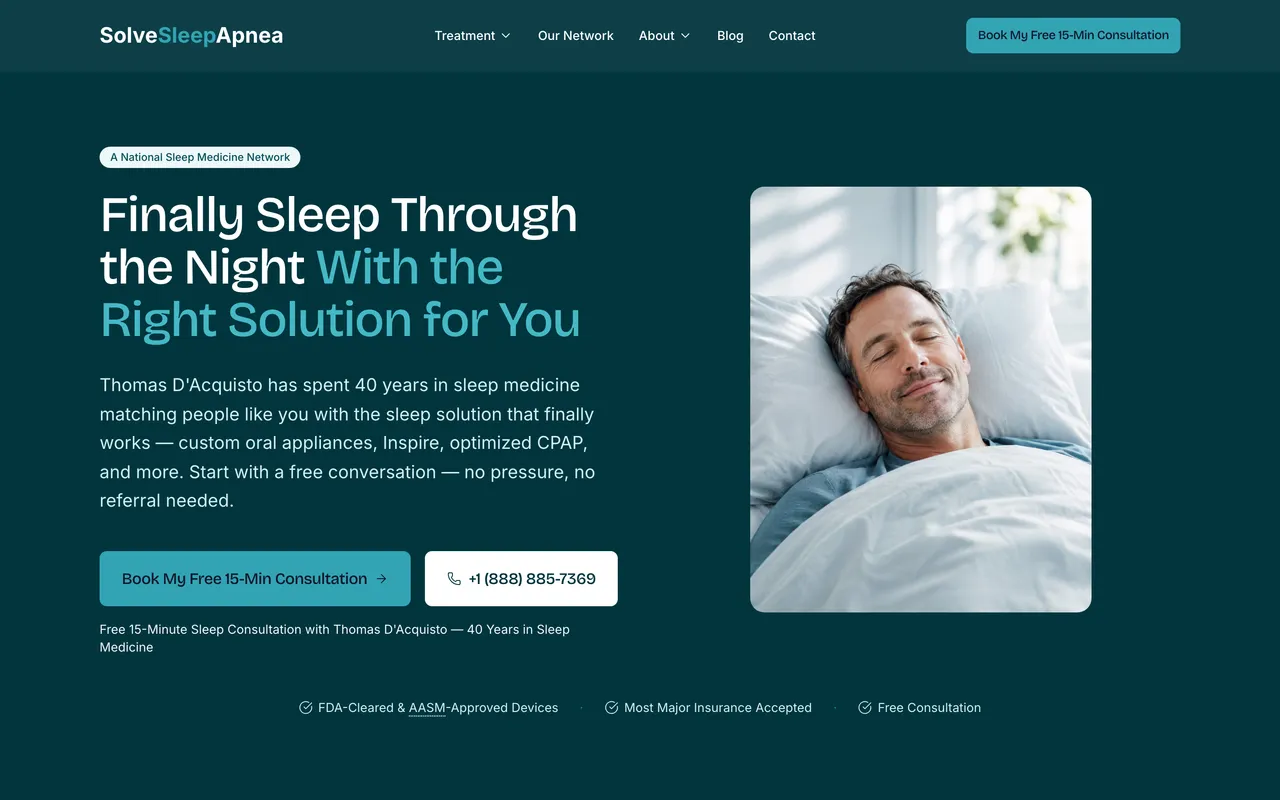
Solve Sleep Apnea
A nationwide sleep apnea network that patients find through search, and that answers them around the clock.
- Healthcare · Co-founded
- Built in 9 months
- SEO pages built to rank by location and keyword
- AI agents qualify and route patients
- partner providers, with a deep focus on San Diego
Most people with sleep apnea start with a search: a symptom, a question, a worry they can’t name yet. Solve Sleep Apnea serves commercial drivers and everyday people, with partner providers nationwide and a deep focus on San Diego, so it has to be there when they ask, wherever they’re asking from.
We built for search from the start: more than 100 SEO pages, each made to rank for a location or a keyword people actually type. Social media carries the same message to people who aren’t searching yet.
Search only pays if someone answers. Every inquiry goes to AI agents, including voice agents, that answer by phone, text and email, qualify and route the patient 24/7, and set or reschedule the appointment. The team runs the consultations and routes each patient to the right partner provider.
What was built, in order
TodayPatients find the network through search and social. Agents answer, qualify and book them by phone, text and email, and the team runs the consultations.
Case 02
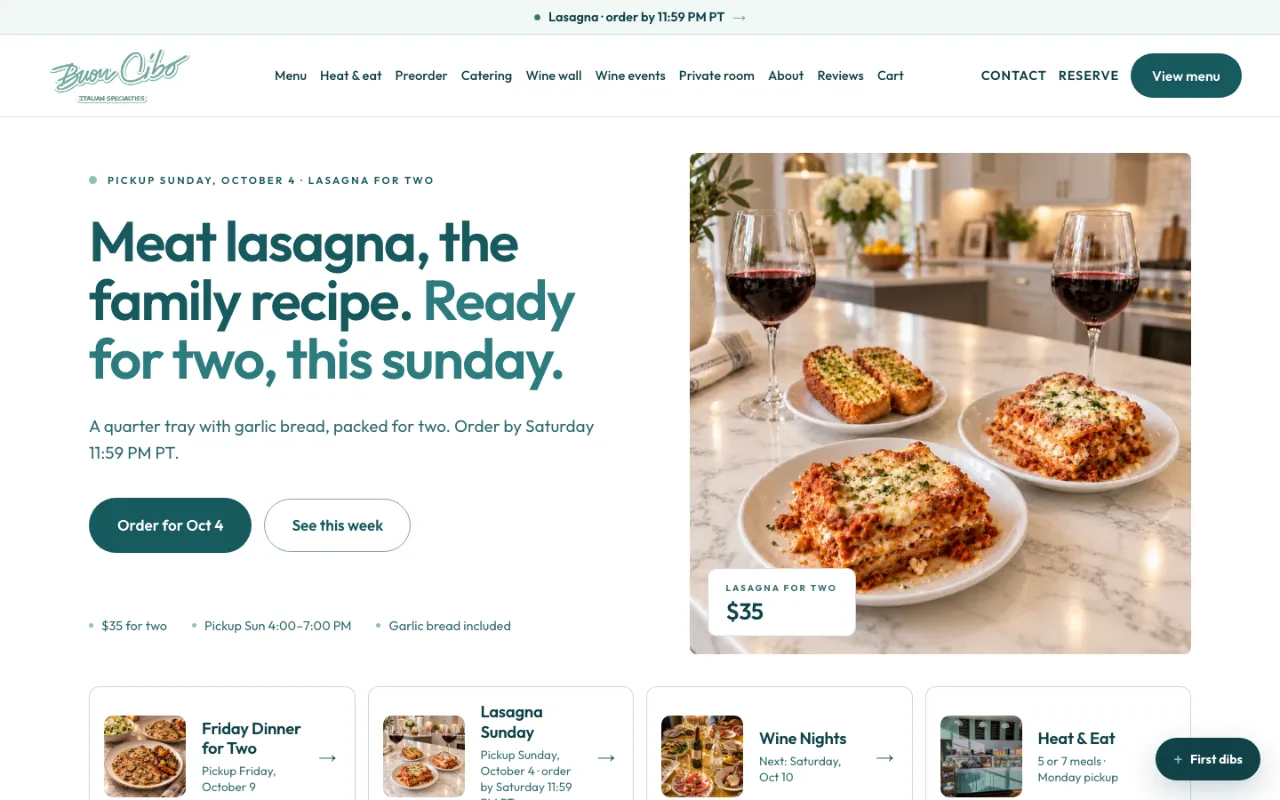
Buon Cibo Italian Specialties
An Italian deli and catering business whose marketing started about a year before the doors opened, so opening day had an audience.
- Restaurant & deli · Scripps Ranch, San Diego
- Marketing began a year before opening
- email subscribers on opening day
- social followers on opening day
- a month in prepaid orders through the website
Most restaurants start marketing when the sign goes up. Buon Cibo, an Italian deli and catering business in Scripps Ranch, started about a year before opening. I built it from the ground up through Clear the Plate, my consulting company for restaurants, markets and delis.
That year went into the audience: an email list and a social following, grown before there was anything to buy. By opening day there were more than 1,500 subscribers and more than 3,000 followers.
The website gives that audience somewhere to act. It takes prepaid preorders for dinners, weekly specials and heat-and-eat meals, plus tickets for wine nights and events, so every email and post has a next step. It brings in about $20,000 a month in prepaid orders, separate from the counter.
What was built, in order
TodayOpen in Scripps Ranch, with dinners, specials, heat-and-eat meals and event tickets sold online ahead of time, separate from the counter.
Chapter 05 · Field notes
What running them taught me.
The rules I now build every campaign around.
Note 01
Answer the lead before you buy the next one.
At Solve Sleep Apnea, AI agents answer every patient by phone, text and email, then qualify and route them, 24/7. Traffic is only worth what happens after the click.
Note 02
Write a page for every question people search.
Solve Sleep Apnea has more than 100 SEO pages, each built to rank for a location or a keyword. One general page competes for everything. A specific page meets someone at the exact question they typed.
Note 03
Own the audience. Rent the reach.
Buon Cibo opened with more than 1,500 people on its email list. Reaching them again costs nothing, and the list doesn’t vanish when an ad budget runs out.
Note 04
Track to the sale, not the click.
Cost per lead, booking rate, show rate, close rate, cost per sale, revenue by campaign. Most businesses watch the first two steps of the path. I track all of them, because a cheap lead that never buys is the most expensive one you have.
FromEvery build
Note 05
Cold email is a list problem first.
More than 1,000,000 cold emails through outreach systems I built taught me that who gets the message matters more than how clever it is. A narrow list and a plain, specific note beat a wide list and a perfect subject line.
FromEvery build
Chapter 06 · The first step
Before any ad spend, a Strategic Blueprint.
Every marketing engagement starts with a Strategic Blueprint. We trace the path from the first click to the sale, find where it leaks, and decide which channels get your budget first, before anything goes live.
It’s yours to keep. Run it with me, with your own team or with someone else.
What’s included
- 01Audit of your current marketing and tracking
- 02Audience and offer strategy
- 03Search and competitor research
- 04Channel strategy and budget priorities
- 05Landing page and follow-up review
- 06Tracking and reporting plan
You leave with
- Offer and audience strategy
- Channel plan, in priority order
- Campaign structure
- Creative testing plan
- Landing page recommendations
- Conversion tracking plan
- Metrics to track, tied to revenue
A Strategic Blueprint usually takes about 10 business days. Depending on the business, anywhere from 2 to 14.
Connect With Me →Chapter 07 · Working together
How we’d work together.
01 · Free
Connect
Text, call or send a message. Tell me where your customers come from now and what you’ve tried, and I’ll tell you where I’d look first.
02
Strategic Blueprint
We audit the path, choose the channels and set the numbers, and you get the written plan.
03
I build and run it
I stay on as your consultant, your builder, or both: the pages and the tracking, the campaigns, and the weekly review against revenue.
Chapter 08 · Questions
Common questions about Marketing & Advertising.
What does a marketing consultant do for a small business?
Builds and runs the path from a stranger to a sale. For me that means the strategy, the landing pages, the lead capture and follow-up, the tracking, and the channels themselves: SEO, content, Google and Meta ads, email and cold outreach, all measured against revenue.
Should I run Google Ads or Meta ads?
It depends on whether your customer is already looking. Google Ads reach people searching for what you sell right now. Meta ads reach people who fit your customer but aren’t searching yet, which takes stronger creative and longer follow-up. Most businesses should start with one, and the Strategic Blueprint decides which.
Should I fix my website before running ads?
If the offer, the landing page or the follow-up is weak, yes. Ads only scale what already exists, so I’ll tell you before we spend, not after the budget’s gone.
Do you do local SEO in San Diego?
Yes. Buy Sell Gold San Diego, a family precious-metals and estate buyer in the Gaslamp Quarter, was built to win local search, with an instant value calculator that gives sellers a reason to reach out. For Solve Sleep Apnea I built more than 100 pages to rank by location and keyword.
Does cold email still work?
It works when it’s narrow and fails when it’s a blast. I’ve sent more than 1,000,000 cold emails through outreach systems I’ve built, and the difference is almost always the list: the right people, a plain message about them, and a fast answer to every reply.
How do you measure marketing ROI?
By following each lead from its source to the sale. I track cost per lead, lead quality, booking rate, show rate, close rate, cost per appointment, cost per sale, revenue by campaign and landing page conversion rate.
Do you do lead generation for my industry?
I’ve built lead generation for restaurants, luxury retail brands and medical businesses. For Luxury Custom Jeweler, a San Diego engagement-ring studio, I built and run the growth engine: the site, the marketing and the lead capture. If your customers search, scroll or check email, the same path applies.
Are you a marketing agency?
No. I’m one person who does the strategy, the pages, the campaigns and the tracking, so nothing gets lost between an account manager, a designer and a media buyer. I’m based in San Diego, where almost all of my work comes by referral, and I work with businesses nationwide.